Will Hk Usp Grey Become Available Again

September 24, 2010
No mode statement here: HK's colors match the gun to the surroundings of the mission.
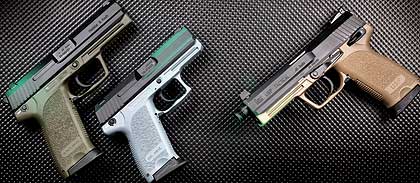
HK'due south colorful triad takes advantage of the nature of polymer frames.
Who says a polymer gun has to be black? HK has announced a limited run of its USP pistols with polymer frames in ane of three colors: tan, green or gray. The colors are designed to blend in with desert, jungle or urban environments.
Those of you lot who haven't been paying attention may have missed the introduction of the Universal Self-Loading Pistol (USP) back in 1993. HK, using its experience with earlier polymer pistols--notably the VP-70 and the P9 serial--brought out the USP in 9mm and .40 S&W. Since many Americans view .45s as the just real handguns, the .45 ACP version followed two years later.
The USP was offered with nine unlike trigger-mode options. Yous could have a dizzying array of safety and trigger packages, from DAO to traditional double activeness to cocked-and-locked, to combinations. I don't know how well that has gone for HK other than making inventory stocking a real problem, merely what was right was the basic package: a durable, reliable, accurate handgun.
In the interests of keeping Handguns readers up to date on all things new and cool, I prevailed upon HK to send me a representative sample of the colorful USP series of pistols. The colour frames are not nevertheless bachelor in 9mm, but .40 and .45 fans have a whole new prepare of toys to play with. The variations currently offered are these configurations: Greyness: USP .45 and USP .40 Meaty; Green: USP .45, USP .xl, USP .twoscore Compact and USP .45 Tactical; Desert Tan: USP .45, USP .xl, USP .40 Compact and USP .45 Tactical and the Marking 23. Suggested retail prices for the colour-frame models are the same as the black-frame variations.
Permit's review the HK family of pistols in lodge from small to big, covering the features as we go.
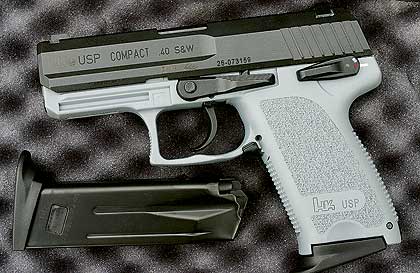
The Compact came in gray, with a definite blue tinge to it.
Meaty USP
As compacts get, this one isn't very compact. I'd hate to take to be working in a hot climate, in light clothing and issued the Meaty USP. At that place are a lot of pistols that are smaller, but non all of them agree 12 rounds of .forty S&West. (The meaty sent to me had a pair of ban-era ten-round magazines.) The grip is very comfortable, with molded checkering front and dorsum and a stippling-like design on the side panels. With standard .twoscore ammo information technology was near sedate in recoil. With the hottest ammo it felt a bit harsher, and the squarish profile of the tang started to become apparent. As a uniform sidearm, the Compact's size is user-friendly and comfy.
The Meaty I received was in grey, and I had to wonder what gray looks similar in Germany. In one of my earlier careers, I learned to employ a printing press and become more than aware of colors. My offset impression on pulling the Meaty out of its carry case was that this gray has bluish in it. Just out of marvel, I pulled out a Pantone Matching Arrangement (PMS) color nautical chart. PMS charts tell you what base of operations colors to mix, and how much, to get a item color on the chart. With a little flake of piece of work I was able to become a pretty close match, and PMS 428 was it. The mixture calls for five-eighths role black, three-eighths part reference blue and 32 parts transparent white. A definite, if subtle, blue tinge shows upward in many kinds of light, but it disappears under fluorescent lighting.
| SPECIFICATIONS: USP/MK 23 Limited-EDITION COLOR FRAME SERIES | ||||
|---|---|---|---|---|
| MAKER: | Heckler & Koch Inc., Dept. HG, 21480 Pacific Blvd., Sterling, VA 20166 (703) 450-1900; www.hecklerkoch-usa.com | |||
| Activity Type: | Locked-breech semiautomatic pistols with various triggers | |||
| Caliber | .40 Southward&W, .45 ACP (in colored polymer) | |||
| CAPACITY: | Compact | Standard | Tactical | MK 23 |
| .40 Southward&W | 12+one | 13+one | (.45 only) | .45 simply) |
| .45 ACP | (.twoscore only) | 12+one | 12+i | 12+i |
| BARREL LENGTH: | Compact | Standard | Tactical | MK 23 |
| Inches* | three.58 | 4.25 | 5.09 | five.87 |
| OVERALL LENGTH: | Compact | Standard | Tactical | MK 23 |
| *Inches | 6.81 | 7.64 | 8.64 | 9.65 |
| WEIGHT: | Compact | Standard | Tactical | MK 23 |
| *Ounces | 23.5 | 26.4 | 30.iv | 38.7 |
| SIGHTS: | Compact | Standard | Tactical | MK 23 |
| Three dot: | Fixed | Fixed | Adjustable | Adjustable |
| Finish: | Bluish steel slides, colored polymer frames | |||
| TRIGGER: | Varies by model and trigger type | |||
| GRIPS: | Cast polymer stippling and checkering | |||
| Cost: | Compact | Standard | Tactical | MK 23 |
| $799-$874 | $769-$839 | $ane,019-$i,115 | $2,412 | |
| *Varies by quotient. Calibers 9x19 and .357 SIG may be offered. | ||||
Recommended
Standard USP
The full-size USP and the Compact are not merely "chopped and channeled" versions of each other; they are dissimilar in proportion, shape and contour. Outset, the slide is longer, both in the barrel-length management and in the slide behind the ejection port. The triggerguard is larger. The grip portion of the frame is larger and not as comfortable every bit the Compact to hold and shoot. The Compact is smaller in circumference, and I find it to be more comfortable to shoot despite its smaller size. Likewise, the magazines are non interchangeable. The Meaty was shipped with steel magazines while the Standard had polymer magazines. Neither would fit in the other, and despite its larger size, the Standard held one more round of .40 than the Meaty did.
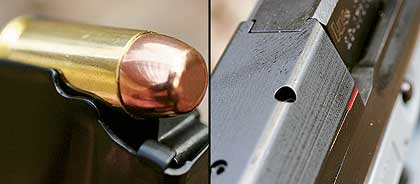
(Left) The USP magazines are double stack but single feed. (Right) Every bit an importation requirement, the "visible" loaded-chamber indicator does the job. On a nighttime and stormy night it is useless.
The hammer of the Compact is flush with the slide while the Standard has a knurled section, making it possible to thumb-cock the larger pistol. (I can't imagine why I'd want to, merely information technology was possible.)
The Standard came to me in OD green, which comes closest to Pantone 4485. That ink color is created by mixing 14 1/2 parts yellow, 1 1/2 parts scarlet red and vi parts black. Yellow and red, to go light-green, and darkened with some blackness--go figure.
USP Tactical
Unlike the two .40s that came in hard-plastic cases, the Tactical came in a zippered nylon case. Inside, the case has pouches for a pair of magazines, a suppressor, a laser aiming module and the pistol. The suppressor and light amplification by stimulated emission of radiation are not HK-made items, so you'll take to contact a manufacturer for those. The example is a transport system, not a tactical case, and getting the pistol or any components out of it is a range event, not an operational result.
The Tactical is bachelor in both .40 and .45, and of the ii I would pick the .45, which is what HK sent me in Desert Tan. While the Standard USP is bigger than the Compact, the Tactical is much larger than the Standard. The Tactical slide has the aforementioned forward length equally the Standard, is longer in the rear and is wider, taller and heavier.
The Tactical barrel protrudes from the slide. In keeping with the Mk 23 origins (the Tactical is a scaled-downward Mk 23, to be more normal in size like the Standard), the muzzle is threaded for a suppressor, and the barrel lockup right behind the muzzle features an O-ring for greater accurateness.

As a polymer frame, the USP has its series number on a metal plate cast in place in the frame.
The sights are large. The front end is a "billboard" reminiscent of the forepart sights seen on bull's-center guns, and the rear is an adaptable--both set in standard HK dovetails. At first I thought to myself, This could benefit from a low-mountain sight installation. Upon further inspection, I wonder if there is room in the top of the slide for a low mount while still existence able to clear the firing-pin tunnel. A low mount may not exist possible--not that whatever HK possessor would subject his pistol to the care of anyone other than an HK-certified armorer.
As I've pointed out, the Tactical is large. For that size you get a .45 that holds 12 rounds and makes nails look like fragile tools. Tan for HK seems to be Pantone 466, a mix of a half-part ruby ruby-red, a half-role process blue, 11?8 parts yellow and 131?8 parts transparent white.
Mk 23
The Mk 23 is a pistol designed past a commission (excuse me, an "Offensive Handgun Weapon arrangement"--yous cannot sell anything to the Defence Department unless it is a "organisation"). The specifications as laid down were impressive: Information technology had to have a service life of thirty,000 rounds of .45 ACP+P ammunition. It had to accept match accuracy. Information technology had to hold 10 rounds (afterwards increased to 12), and it had to be capable of accepting both a suppressor and a laser aiming module. Equally a 1911 aficionado and an IPSC shooter, I am amused that the committee did non spend and then much as five minutes considering that the 1911 could accept met all requirements (every bit many have).
| CHRONOGRAPH Information FOR HK USP | ||
|---|---|---|
| Ammunition | Compact USP, .forty | Standard USP, .40 |
| 135-gr. Cor-Bon Powrball | one,155 | ane,238 |
| 165-gr. Rem. Golden Sabre | 994 | 1,020 |
| 165-gr. PMC FMJ | 876 | 904 |
| 180-gr. FMJ Black Hills Blue | 875 | 930 |
| Tactical .45 ACP | MK23 | |
| 165-gr. Cor-Bon Powrball | 1,104 | 1,111 |
| 230-gr. JRN PMC | 788 | 804 |
| 230-gr. JHP Cor-Bon +P | 897 | 999 |
| 220-gr. JRN PMP | 843 | 857 |
| 230-gr. JHP Speer Aureate Dot | 827 | 842 |
| 230-gr. SXT W-W Ranger | 833 | 845 |
| 230-gr. JRN Black Hills Blue | 813 | 844 |
| 230-gr. JRN IMI | 886 | 887 |
This thing is huge. It makes the USP Compact wait similar an talocrural joint gun. My test-burn down crew spent a lot of fourth dimension fondling the Mk 23, and all came to the same determination: The grip is too big. Simply if you are going to make a polymer-framed gun that holds 12 rounds of .45 ACP, you'll end up with a big grip. The triggerguard is large enough to go iii fingers in there, not that yous'd need them to pull the trigger.
One thing that tin be said well-nigh the HK modern trigger system on the USP models is that information technology is uniformly squeamish. The Mk 23 in detail, in single action, was very useable. I've shot a lot of matches in the past with custom guns whose triggers were non every bit crisp and clean as the Mk 23 had right out of the box.
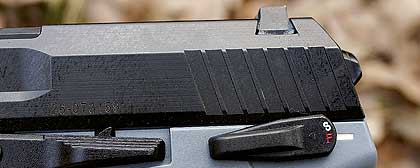
The HK trigger package options are non user-serviceable. If you want a parcel, order it. Here we see the single-activity safety and double-action decocker option.
One thing that can be said nearly the HK modernistic trigger organisation on the USP models is that it is uniformly squeamish. The Mk 23 in detail, in single action, was very useable. I've shot a lot of matches in the past with custom guns whose triggers were not equally crisp and clean as the Mk 23 had right out of the box.
Magazines for the Mk 23 and the Tactical use the same tubes. The Mk 23 magazines volition lock into the Tactical but non the reverse. The baseplates on the Tactical magazines strike the Mk 23 frame before the tube tin can lock in place. If you want to employ your HK 45 magazines interchangeably, you'll have to install Mk 23 baseplates on them.
The safety on the Mk 23 is worthy of that overused elevation in the modern era: unique. The trigger action is both a double activeness and a single activeness. The safe is an ambidextrous lever that blocks the activity only in single action. If you lot are using it every bit a double-action-first-shot pistol, the safety lever won't move upwardly. Once you take it cocked, you have the option of either engaging the pollex safe or using the divide decocking lever to lower the hammer--that's right, both a unmarried-action thumb rubber and a split decocking lever. When the pollex safety is on, the decocking lever doesn't motility. I've seen a lot of handguns, and I don't recall whatever other that has this combination.
Considering the specifications laid down by the commission, HK did a superb job with the Mk 23, superb enough that it won the contract and provided the authorities with a truckload of handguns larger than some compact submachine guns.
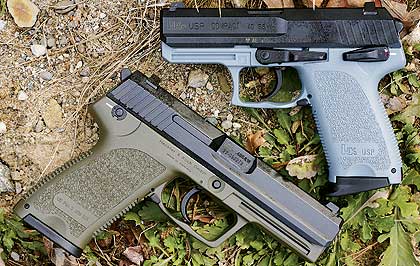
The Compact and Standard are not just smaller and bigger pistols; in that location are differences. Hither you can see the OD green compared to the gray.
As much fun as trying to match the colors was, all information technology proves is that colour-matching is an art. Trying to become an ink color, which will coat newspaper, matched with a color that is suffused throughout a polymer resin is like comparing apples and oranges.
All the USP models and the Mk 23 had 2 things in mutual: a lanyard loop in the bottom rear of the frame and a mechanical lock built into that lanyard housing. Lanyards are one of those old war machine features that are new again. In scrambling over destroyed buildings, through thick jungle or when completely exhausted, if some necessary slice of armed services equipment isn't securely attached to you lot, it is probable to come up up missing.
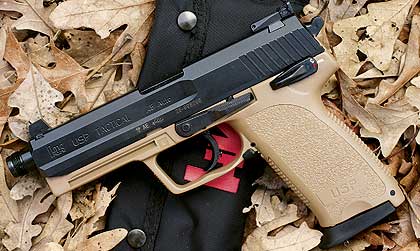
The Tactical is a big gun, as befits its 12-round .45 ACP capacity and Mk 23 heritage.
As for the mechanical lock, it is 1 of those things necessitated past attorneys and legislators. The HK method needs a special two-pronged key to turn it and won't keep past itself. So if you never knew it was there and never used information technology, you'd never observe it. If you do need information technology or want it, driblet the mag, and look in the mag well, toward the backstrap. In that location you'll observe a round button with ii holes in it. Use the key to plough the button and then the holes are vertical, and the hammer is blocked. With it locked, you lot tin can't work the slide or cock the hammer.
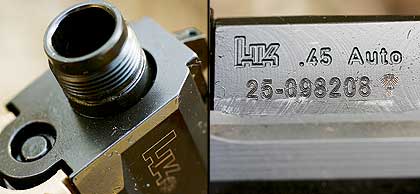
(Correct) The MK 23 cage is threaded for a suppressor. (Left) High german proof law: All barrels must be marked with maker, caliber, serial number and acceptance proof. Skillful thing there is room.
Enough of the overview--how practice they shoot? As you lot'd expect an HK product to shoot, they are utterly reliable and with superb accuracy. Lacking Bribe-rest inserts for them, I had to content myself with shooting off the bench for accurateness. All the HKs shot likewise as some custom guns I had with me on the same range session. The Mk 23 was particularly accurate, and I was able to shoot several groups under two inches at 25 yards using plain sometime ball ammo. (Hey, I'm no Ransom residue. Two inches at 25 yards with iron sights and blasting/non-match ammo is actually proficient.) The 100-m gongs were not safety from whatsoever of them, the Meaty included. A clean trigger pause on my part would always lead to a satisfying "clink" from downrange.
For such large guns, the HKs all rolled in my hands more I like. More than than one test-burn down volunteer commented on the cage ascension, especially in the Mk 23. Archimedes, once he got over the shock of firearms, could tell the states why in a moment: It was the length of the lever arm. The axis of the bore on the USP pistols is higher than on other pistols. The Mk 23 in particular has a bore that looks like information technology is a foot and a half over your hands. With more leverage, the USPs can pin more. Information technology's not that the recoil is harder, or even objectionable, just that you'll encounter a lot more cage activeness than you lot're used to.
I happened to have a selection of 1911s and a Browning Hi-Power along on the same trip, and the differences were noticeable. Later, 1 of my young man order members showed up with his French MAB-fifteen, and it also has a higher bore than Browning pistols practice. In shooting it, we noticed that it has as much muzzle rising as a 9mm, as the Compact USP did as a .40.
I am not picking on the USP. The fact that the muzzle rises higher does not hateful it kicks harder. And for fast shooting, you will spend more fourth dimension aiming than in recoil recovery anyway, so muzzle rise doesn't matter.
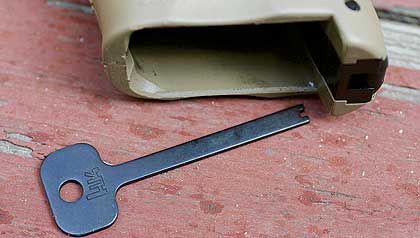
The HK mechanism lock fundamental. If you lock your guns, don't lose this tool.
The longer barrel of the Mk 23 likewise gave usa more velocity than any other pistol forth that twenty-four hours. If y'all're starting with +P ammo, the longer barrel of the Mk 23 is going to heave the velocity even more. Even standard ammo ended upwardly delivering near bowling-pin-load velocities, and the +P ammo was hotter still.
Which would I select? Of the offerings sent me by HK, I call up I'd accept to give the nod to the Tactical in any kind of applied shooting competition. The size and mass dampen recoil, the magazines give good capacity, and you tin't beat the accuracy or reliability. For the size and caliber of the .40s, I found the bulk a fleck much for the Compact to be meaty, and the recoil of the Standard felt the same as the Meaty. If I were going to acquit one on duty, I would consider the Compact as a great compatible duty gun. None was pocket-sized plenty to tempt me into concealed carry.
As for the "utility" of putting a suppressor on a handgun, were I in the position of going afterwards very bad people using a suppressor, I'd much rather adhere a tin can to an M4 or an MP-five than turn the already big Mk 23 into an even bigger gun.
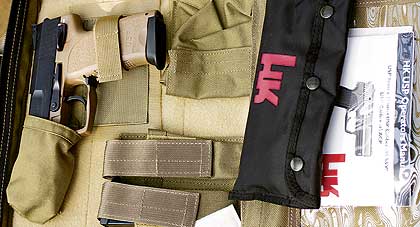
The big Mk 23 in its nylon acquit instance.
And the color? I'd go with OD greenish. The gray, every bit I mentioned, is just a little too blue for me. Desert Tan is not a color I can go into. Simply OD light-green? I tin go for that.
Source: https://www.handgunsmag.com/editorial/featured_handguns_hk_091305/138969
0 Response to "Will Hk Usp Grey Become Available Again"
Post a Comment