Can You Get Acute Compartment Syndrome Again
Commodity Featured on Medicinenet.com
Compartment syndrome is a serious condition that occurs when there'southward a large amount of pressure level within a muscle compartment. Larn more nigh this syndrome including symptoms, diagnosis, treatment options, and more.
Compartment syndrome facts
- Compartment syndrome describes increased pressure within a musculus compartment of the arm or leg. It is most oftentimes due to injury, such as fracture, that causes bleeding in a muscle, which then causes increased pressure in the muscle. This pressure increase causes nerve damage due to decreased blood supply.
- Symptoms include severe pain, numbness, and decreased range of motion.
- Surgery (fasciotomy) is the only treatment for acute compartment syndrome. The musculus compartment is cut open to allow muscle tissue to neat, decrease pressure and restore blood flow.
- Complications may include muscle loss, amputation, infection, nerve harm, and kidney failure.
- Prevention efforts include ice and acme of the affected extremity.
- Chronic compartment syndrome commonly requires no handling or surgery.
What is compartment syndrome?
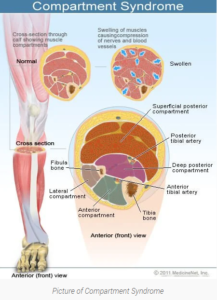
Compartment syndrome is a condition that occurs when injury causes generalized painful swelling and increased pressure inside a compartment to the point that blood cannot supply the muscles and nerves with oxygen and nutrients. Muscles in the forearm, lower leg and other body areas are surrounded by fibrous bands of tissues. This creates distinct compartments. The fibrous tissue is very inflexible and cannot stretch to adapt the generalized swelling. If left untreated, muscles and nerves fail and may eventually die.
While almost often occurring in the forearm and lower leg, compartment syndrome can rarely occur in other parts of the trunk that accept muscles contained in compartments, including the hands and feet.
Compartment syndrome may occur acutely due to swelling that arises from injury, or information technology may be chronic because of exertion such equally exercise.
Whatcauses compartment syndrome?
Muscles are contained in compartments covered by thick gristly bands of tissue or fascia. Because of injury, pressure level can increase within the compartment to swelling (fluid accumulation) or bleeding. In non-contracting muscle, the compartment pressure is usually almost 0-15 mmHg of force per unit area. If the pressure level within the compartment increases (usually greater than about thirty -45mmHg; or are within thirty mm of the diastolic blood pressure) most individuals develop compartment syndrome. When these loftier compartment pressures are present, blood cannot broadcast to the muscles and nerves to supply them with oxygen and nutrients. Symptoms such as pain and swelling will result.
Every bit the muscle cells lose their claret and oxygen supply, they begin to dice. If the status is not recognized and treated, the whole musculus tin can dice, scar down, and contract. Similarly, nerve cells that are damaged may neglect causing numbness and weakness in the structures beyond the injury site. If infection or necrosis develops, the private may need the limb amputated to forbid death.
What are the risk factors for compartment syndrome?
Acute compartment syndrome occurs as a complication of an injury. Oft information technology is due to a fracture of the radius or ulna in the forearm or the tibia and fibula in the lower leg that causes significant bleeding in 1 or more of the compartments. Haemorrhage can also exist due to a badly bruised musculus. Crush injuries may cause both bleeding and swelling of a muscle.
Some injuries tin exist more subtle. If a person is incapacitated and immobile for a prolonged period of time, for example, due to alcohol or drug intoxication, swelling or musculus impairment may occur because a blood vessel was compressed. The weight of an object (or the weight of the body itself) compressing a muscle group can cause rhabdomyolysis (muscle breakdown).
Compartment swelling may occur afterward the blood supply is re-established (reperfusion swelling) to an expanse that has lost it for a menses of time. Two examples are: i) a person is in an auto accident where their legs are trapped and compressed with heavy debris, which are after freed from the droppings after a period of time; 2) when a blood vessel is damaged and subsequently repaired through surgery.
Compartment syndrome may be a complication of bandages or casts that are practical too tightly, or due to swelling that occurs later on casting.
Other precipitous causes of compartment syndrome include burns, snake bites and other envenomation, and anabolic steroid use. Individuals taking anticoagulants take a college risk for compartment syndrome subsequently trauma due to bleeding that cannot clot commonly. Because at that place is some controversy nigh when fasciotomy is required (peculiarly with snake bites) immediate consultation with a surgeon is recommended by nigh experts.
Chronic compartment syndrome occurs because of excessive exercise, where repetitive motion and muscle use crusade localized swelling and irritation. Near often, symptoms in the legs are seen with runners and bicyclists and in the arms of swimmers. Symptoms resolve with rest and very rarely progress to an acute limb threatening situation.
What are thesymptoms and signs of compartment syndrome?
The symptoms of compartment syndrome, plus the circumstances that led to their development assist to make the clinical diagnosis. Pain out of proportion to the injury (or physical examination of the muscle compartment) oft is the inkling to make the diagnosis of compartment syndrome. Increased pressure level inside the musculus compartment causes loss of blood supply and nervus inflammation. This causes meaning pain and numbness or paresthesia. (para=abnormal + ethesia=feeling).
The diagnosis should be always considered when in that location is either an associated fracture, high velocity injury like a gunshot wound or a shell injury. Individuals who are taking anticoagulant medications such every bit warfarin (Coumadin) or enoxaparin (Lovenox) are at higher take chances for bleeding into a compartment spontaneously or after injury.
Historically, the mnemonic memory device for compartment syndrome is the "5 Ps" (pain, paresthesia [change in sensation], pallor [pale coloration], paralysis, and poikilothermia [inability to control temperature]; some authors include pulselessness), but this should not be relied upon to make a diagnosis. Just pain and modify in sensation (parathesia) may exist symptoms that indicate to the diagnosis of a developing compartment syndrome.
Test of the extremity oft reveals tense and shiny skin that may be significantly bruised. Pain occurs with minimal range of motion of the human foot, hand, or any of the extremity with compartment syndrome. The patient may have difficulty moving the extremity without aid and pain is provoked when the intendance practitioner takes the affected limb though any range of motion
In chronic compartment syndrome, there may be pain with range of motion of the extremity and musculus bulging may be noticed. Numbness is common but all symptoms usually resolve inside a few minutes of discontinuing exercise.
When should I seek medical intendance for compartment syndrome?
Acute compartment syndrome is a truthful emergency. If the pressure level within the compartment is non released within a few hours, permanent muscle and nerve damage may occur.
Medical care should be accessed when numbness, tingling, weakness, or excessive hurting occurs after an injury. While compartment syndrome is near often due to injuries of the forearm and lower leg, it may also occur in the hand, foot, or buttocks afterwards a broken bone or crush injury.
How is compartment syndrome diagnosed?
While it is uncommon, the health care practitioner has to have a loftier index of suspicion for acute compartment syndrome if a patient presents with excessive hurting, numbness, and a tense extremity after an injury. The patient'due south history of an injury to the extremity often is all that is necessary for a diagnosis.
While blood tests may be ordered to look for chemical markers of musculus injury (for example, myoglobin and lactate levels) and kidney harm, the definitive diagnosis of compartment syndrome is confirmed by measuring the pressure within the compartments of the affected limb. A sterile needle is inserted directly into the musculus compartment and attached to a pressure level monitoring device (meet 2nd-concluding reference for flick). Usually, pressure level measurements (see values listed above) are taken in each compartment in the affected limb and this may require multiple needle sticks.
Chronic compartment syndrome may be diagnosed clinically but compartment pressures may be measured earlier and afterward exercise to confirm the diagnosis. The health care professional person should also explore other potential causes of pain due to practise, including stress fractures, shin splints, or tendon inflammation.
What is thetreatment for compartment syndrome?
Prevention is the first step in the handling of compartment syndrome. Significant injuries of the arms and legs that require casting or splinting should ever be elevated and iced to minimize the potential for swelling. Elevation should be to a higher place the level of the heart. Ice therapy may even be considered even if a cast or splint has been placed.
Chronic or exercise induced compartment syndrome rarely requires any treatment; the pain and other symptoms usually stop minutes to hours after the activity is stopped. However, some individuals, over fourth dimension, find the chronic compartment syndrome to exist very limiting, especially if it causes them to stop a favorite sport (for example, running, lawn tennis, or football game). Rarely, such individuals may accept a surgeon cutting open some of the fascia that surrounds the compartment to reduce or terminate the symptoms.
Surgery (fasciotomy)
The handling for astute compartment syndrome is surgery (fasciotomy). The surgeon (either an orthopedic or full general surgeon) will perform a fasciotomy (see last reference for video of procedure), an functioning where the thick, fibrous bands that line the muscles are filleted open up, allowing the muscles to bang-up and salve the pressure inside the compartment (similar to splitting open up the casing of a sausage). Depending upon the amount of swelling (edema), a second operation may be required afterward to close the skin afterwards the swelling has resolved.
Once acute compartment syndrome has occurred, there is no non-surgical alternative. Hyperbaric oxygen may be considered equally an offshoot treatment after surgery to promote healing.
Handling will also exist directed to the underlying cause of the compartment syndrome and to try to forestall other associated complications including kidney failure due to rhabdomyolysis.
What are the complications of compartment syndrome?
Left unrecognized or untreated, the complications of astute compartment syndrome are irreversible. As swelling increases and muscle loses its blood supply, cells eventually die and muscle necrosis occurs. Complications include:
- muscle scarring, contracture and loss of function of the limb;
- infection;
- amputation;
- permanent nerve damage; and/or
- rhabdomyolysis (muscle breakdown) and kidney damage.
Complications due to chronic or exercise induced compartment syndrome are rare merely may include whatsoever of the above, especially if the person requires surgery to alleviate the chronic condition.
What is the prognosis for compartment syndrome?
Acute compartment syndrome is a potentially devastating condition. Return of normal part and minimizing injury depends upon quick recognition of the state of affairs and prompt surgical fasciotomy to resolve the increased pressure. The longer the filibuster to surgery, the more potential for permanent loss of muscle and nerve function. The prognosis for chronic compartment syndrome is usually first-class.
Orthopedic & Sports Medicine Center of Oregon is an award-winning, board-certified orthopedic grouping located in downtown Portland Oregon. Nosotros utilize both surgical and nonsurgical means to treat musculoskeletal trauma, spine diseases, sports injuries, degenerative diseases, infections, tumors and congenital disorders.
Our mission is to return our patients back to pain-gratis mobility and total strength as quickly and painlessly as possible using both surgical and non-surgical orthopedic procedures.
Our good physicians provide leading-edge, comprehensive intendance in the diagnosis and treatment of orthopedic conditions, including total joint replacement and sports medicine. Nosotros apply the latest land-of-the-art techniques in order to render our patients to their active lifestyle.
If y'all're looking for compassionate, expert orthopedic surgeons in Portland Oregon, contact OSM today.
Telephone:
503-224-8399
Address
1515 NW 18th Ave, 3rd Floor
Portland, OR 97209
Hours
Monday–Friday
eight:00am – 4:30pm
Source: https://orthosportsmed.com/understanding-compartment-syndrome-what-is-it-and-how-to-recover/
0 Response to "Can You Get Acute Compartment Syndrome Again"
Post a Comment