Surface Book 2 Review From a Mac User
I take to acknowledge, ever since Microsoft released the Surface Pro laptops, I take been a fan of these travel-friendly and light ii-in-1 machines. I take written about my experience with the Surface Pro two from a photographer's perspective a while dorsum, so we wrote a detailed Surface Pro 3 review and my experience with the first generation Surface Book pretty much sealed information technology for me as a very desirable car for working on the become, thank you to its excellent functioning, flexible design, a born retention card slot, superb touchscreen feel and plenty of connectivity options. Earlier this year Microsoft finally released the Surface Book two, a 2nd generation laptop specifically designed to claiming Apple's MacBook Pro. Since it was near fourth dimension to start replacing my crumbling Surface Pro 3, I wanted to evaluate both the new Surface Volume 2 and Apple'southward MacBook Pro to encounter which I would pick for my photography needs. So I bought both laptops and decided to run them side-by-side to see which one would be more than suitable to use for traveling and post-processing images. In this article, we volition accept a wait at both the Surface Book 2 and the MacBook Pro and see how they stack up against each other.
Update: Per requests from our readers, we have included more CPU benchmarks and updated the summary to reverberate our findings.
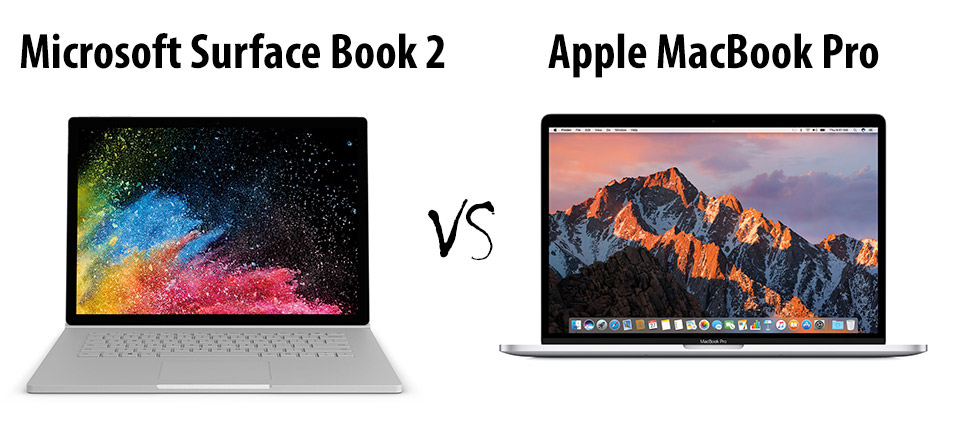
First, let's have a look at how the ii compare when it comes to specifications.
Surface Book two vs MacBook Pro Specifications Comparing
| Laptop Characteristic | Microsoft Surface Book 2 | Apple MacBook Pro |
|---|---|---|
| Operating System | Windows ten Creators Update | MacOS High Sierra |
| Top CPU | Intel Core i7-8650U i.90 GHz (8th Generation) | Intel Core i7-7920HQ 2.7 Ghz (7th Generation) |
| CPU Cores / Threads | 4 / 8 | 4 / 8 |
| Elevation GPU | NVIDIA GeForce GTX 1060 | Radeon Pro 560 |
| RAM | viii GB – 16 GB | 8 GB – xvi GB |
| Storage | 256 GB – 1 TB | 256 GB – two TB |
| Screen Size | fifteen″ | 15.4″ |
| Screen Resolution | 3240 x 2160 | 2880 x 1800 |
| Touchscreen | Aye | No |
| Ports | 2 x USB Type-A, 1 x USB Type-C | 4 x Thunderbolt three via USB Blazon-C |
| SD Menu Slot | Yes | No |
| Battery Life | 17 Hours | ten Hours |
| Cameras | 5 MP Front end, 8 MP Rear | 720p Facetime Hard disk drive |
| Dimensions | 343mm x 251mm 10 xv-23mm | 349mm x 241mm x 16mm |
| Weight | i.9 kg | 1.83 kg |
| MSRP Price | $1,499 – $iii,299 | $ii,399 – $4,179 |
| Comparable Top Config Cost | $iii,299 | $3,349 |
At the moment, Apple does not accept whatever laptops that use 8th generation CPUs from Intel. This means that they are not going to be direct comparable to Surface Book two laptops, especially when it comes to battery life, since the eighth generation Intel CPUs are more power efficient in comparison. Nevertheless, based on the to a higher place specifications, you tin can easily see that there are pretty noticeable differences betwixt these laptops.
First of all, aside from the more power efficient and faster CPU, the Surface Book ii has a better GPU on its peak-stop models. The NVIDIA GeForce GTX 1060 is a pretty powerful GPU that outperforms the Radeon Pro 560, as can exist seen in the comparisons below.
2nd, different Apple tree that decided to throw away USB ports and an SD card port birthday, Microsoft kept two USB Type-A ports also as an SD card slot and added a single USB Type-C port to brand it easier for people to transition from older to newer applied science. Unfortunately, Microsoft screwed upwards with its USB Type-C port by not incorporating Thunderbolt 3 capability – that'southward something that should have been there, especially to aid those Mac users that want to transition to the PC platform. Still, removal of the USB ports, besides equally the SD carte slot was a big mistake on behalf of Apple in my opinion, peculiarly for us photographers who heavily rely on USB-powered equipment such as Wacom tablets and external difficult drives, as well as SD cards for transferring media content to our computers. Thunderbolt is not mainstream withal to make such a rough transition, which ways that one has to utilize actress connection gadgets on the MacBook Pro to be able to use existing equipment. And that'due south more tools to carry in an already tight photographic camera bag!
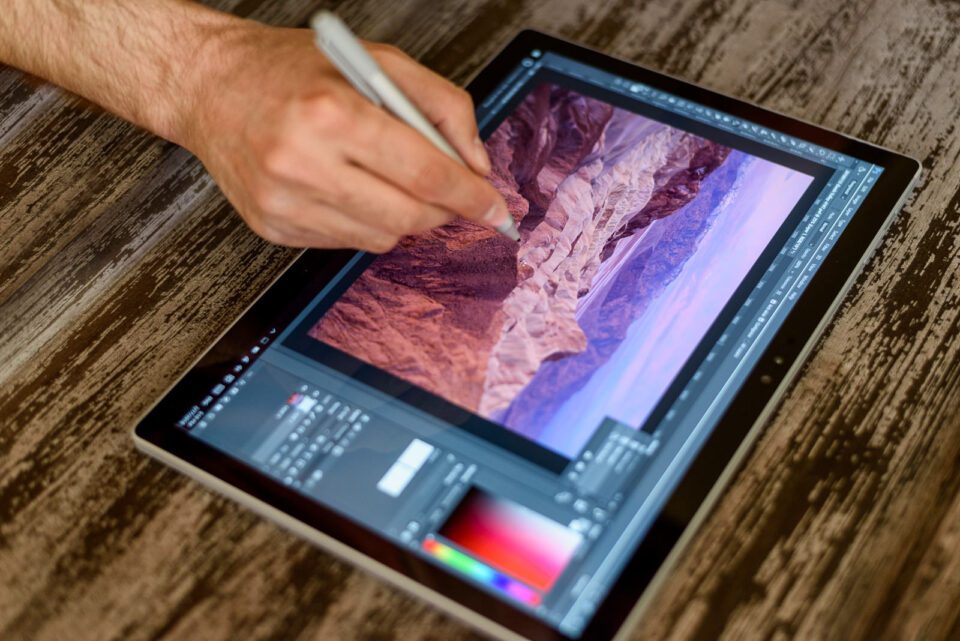
Tertiary, the Surface Book 2 has 2 distinct advantages over the MacBook Pro that are very important for photography needs – and those are touchscreen capability, every bit well every bit being able to disassemble the screen from the keyboard. While for some people this might seem similar a "nice to have" feature, one time you get used to these capabilities, it is difficult to get back to a traditional laptop. The touchscreen + pen combination eliminates the need to deport a Wacom device, which not just frees upwardly infinite in a laptop pocketbook, just likewise eliminates the need to carry more tools and cables when traveling. Couple that with the ability to disassemble the keyboard base from the master unit of measurement and you lot take the ability to apply the Surface Volume as a tablet, and so it could work every bit an iPad replacement as well. In addition, the ability to disassemble the screen allows it to be reversed and used on top of the keyboard base to provide fast GPU and boosted battery capabilities, and then one could utilise the pen without little with the keyboard.
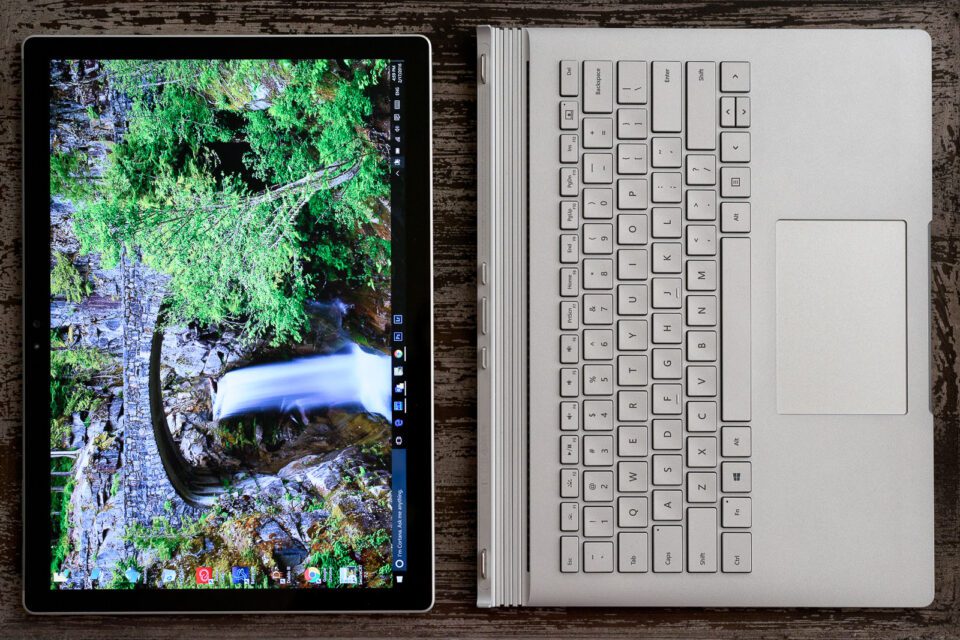
Lastly, the keyboard surface area on the Surface Book 2 does not become nearly as hot every bit it does on the MacBook Pro, which is a pretty big deal for someone similar me who often works with laptops on their lap. Since the CPU, memory, LCD screen, part of the laptop battery and other components are kept on the tiptop base unit, most of the heat that is produced by heavy loads stays on the top. The simply time the Surface Book 2 keyboard area tin get warm is when the battery gets charged and the GPU is used a lot. Even then, the Surface Book 2 always stays noticeably libation compared to the MacBook Pro at the base when in use.
While both laptops are priced somewhat similarly, considering the above, you simply become quite a lot more value out of the Surface Book 2 when compared to the MacBook Pro. While many Apple fans will defend their choice of Apple tree hardware due to OS superiority, they near probable have non experienced Windows 10 + Surface combination. We are non talking about Windows 98, ME or other Microsoft failures of the past – Windows 10 is a pretty potent Os, especially when it natively runs on Microsoft hardware.
Build Quality Comparing
I have been running Microsoft Surface Book 2 from the 24-hour interval it became publicly available and I have had the MacBook Pro for over a calendar month now. When it comes to packaging, both companies go out of their style to brand certain that their products are presentable – the laptops are packaged very nicely and the unboxing experience is a pure pleasure. The same goes for build quality – both laptops are built exceptionally well and should concluding a long time if they are properly taken intendance of.
MacBook Charger vs Surface Book Magnetic Charger
There are some things to like and not to similar most the new Apple MacBook. On i manus, I love the fact that one tin can charge the MacBook Pro through any of the USB-C ports on either side of the machine. This is really cool, because you don't have to worry about putting the cable effectually the laptop when the power source is on the incorrect side. On the other hand, abandoning MagSafe and going with a cable that stays firmly attached once plugged in, is certainly non something Apple fans have been excited near. MagSafe has been an Apple standard for many years now and many MacBook Pro users have gotten used to not having to worry about their machines in case someone trips on the cable – the magnet would safely detach from the computer. Not anymore – ane has to spotter out and e'er brand sure to disassemble the cable when in that location is a gamble of tripping on it. Microsoft banked on Apple's MagSafe thought ever since the Surface machines came out and it has been using the same magnetic power attachment on every Surface model at present, including the Surface Volume 2. That'southward only one less issue to worry about.
Keyboard, Trackpad and Touch Bar
Both laptops accept fantabulous keyboards, but they feel completely unlike when typing. The keys on the Surface Volume stick out a bit more compared to those on the MacBook Pro, but pressing them does not make them feel harder in comparing. I personally prefer typing on the Surface Volume 2, but that'due south completely subjective – I would recommend to feel both and encounter which 1 yous like improve.
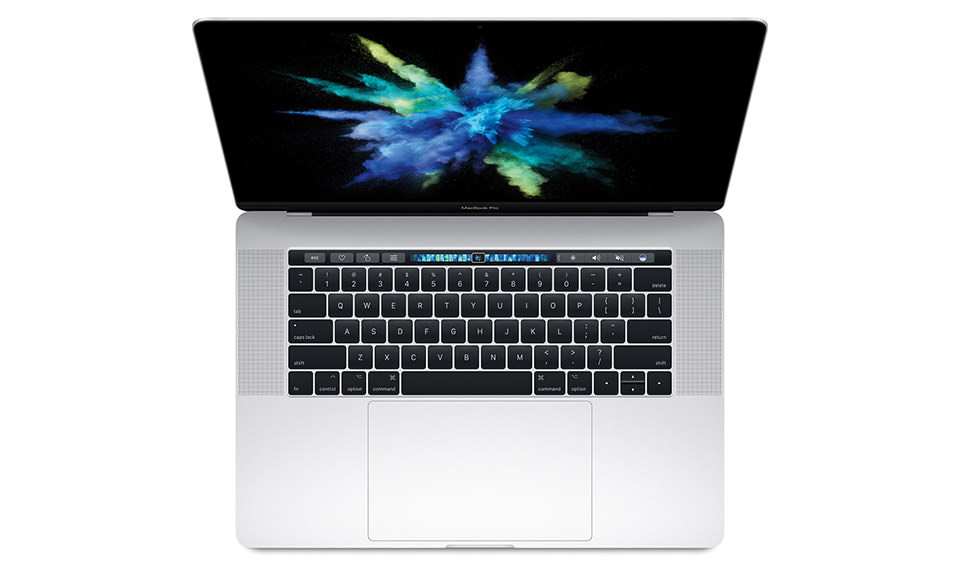
Trackpad, on the other paw, is a unlike animal. While Microsoft has done well with its latest generation trackpad, information technology just does not compete with the MacBook Pro'due south monstrous trackpad. It is huge! Size-wise, you could fit more than 2 trackpads from the Surface Book 2 on the MacBook Pro! But it is not the size that matters. When it comes to tactile experience, gestures and overall responsiveness, Apple reigns supreme.
Every bit for affect bar, while many Apple tree fans do not seem to like it, I personally don't mind it. It is actually nice to be able to utilize such controls as volume upwardly / down without having to recall dissimilar key combinations and information technology is certainly absurd to be able to have controls that vary past application. I think the touch on bar is a great idea in the long run and something that volition proceeds popularity overtime. The biggest difficulty is for those who are very used to using function keys and the escape key in different software applications (especially programmers). For those folks, the older keyboard layout is going to exist obviously preferable.
Performance Comparing: CPU, GPU and Storage Benchmarks
Let's accept a look at how the new Microsoft Surface Book two compares to the current generation MacBook Pro. I ran 2 different benchmarks on both – Cinebench and Novabench a total of 3 times and took the all-time score from both. We will start with Novabench:
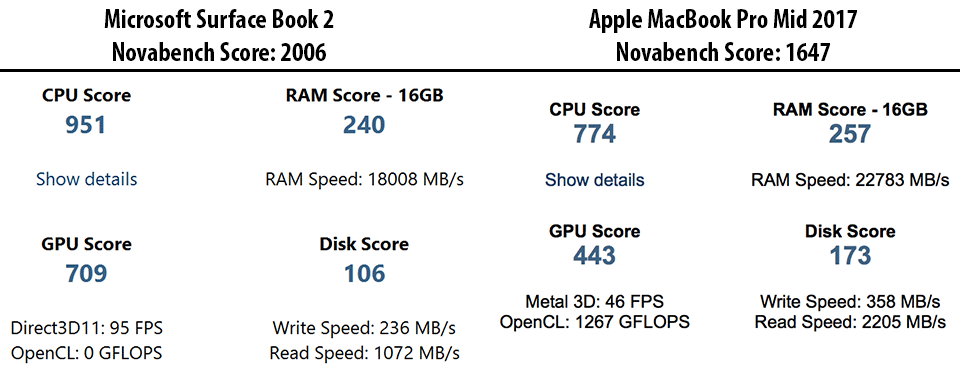
Novabench provides a number of dissimilar benchmarks, which makes it very interesting to wait at. As expected, the Surface Book 2 scores a chip college due to having a newer and faster CPU. Its graphics (GPU) functioning is also impressive – it managed to get 95 fps when rendering a 3D scene and scored significantly higher at 709 compared to 443 on the MacBook Pro. Nonetheless, the right side of the chart is where Apple dominates. Information technology not simply has faster RAM, but its storage is twice faster, which is significant. I am not sure what type of storage Microsoft uses in its Surface Volume 2, only it is nowhere equally skillful as what's inside the MacBook Pro. Faster storage is important for photography needs, because it makes a big difference when working with files in post-processing software like Lightroom. And as yous will run into below, the MacBook Pro is going to come up out as a faster machine for generating previews and exporting files purely because of this. For other CPU or GPU-intensive tasks, the Surface Book two is a improve automobile, but because that many post-processing software tools out there are not properly optimized to take advantage of dedicated GPU cards, the latter is not all that of import.
Let'south now take a await at Cinebench, which specializes in CPU and GPU performance:
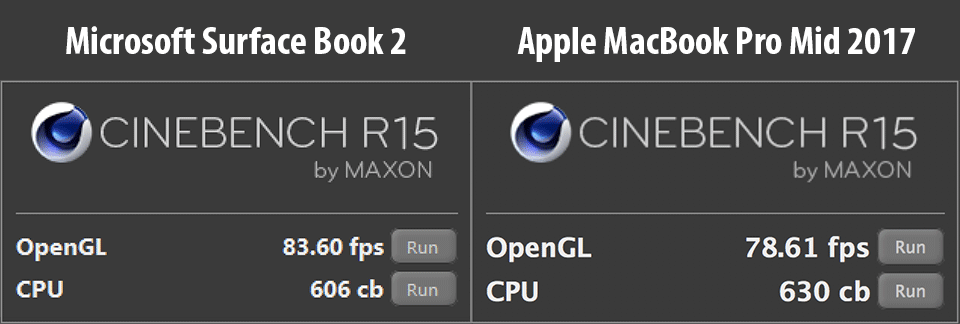
Hither, nosotros can see that the deviation between the 2 is a bit dissimilar. While the Surface Book 2 scores higher in OpenGL performance, its CPU performance does not seem to be every bit good as on the MacBook Pro when rendering complex 3D images. Hither, the MacBook Pro came out on summit.
Let'south at present take a await at the CrystalDiskMark benchmarks on the Surface Book 2 with 512 GB of NVMe storage:
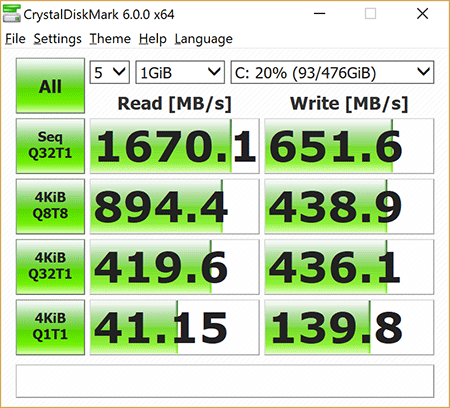
The above numbers are pretty disappointing, considering that the ane TB version of the Surface Book ii can get virtually twice the performance in comparison. I am not sure why Microsoft opted for a much slower 512 GB NVMe bulldoze when Apple is pushing the fastest storage options bachelor. To get faster performance, you volition demand to spend a lot more money on the Surface Book ii, which is already pretty darn expensive…
Overall, looks like both machines have their strengths and weaknesses. While the Surface Book 2 has solid CPU and GPU performance, it lags big time when it comes to storage performance, something the MacBook Pro truly excels at.
Performance Comparing: Lightroom Previews and Export
For this particular benchmark, I imported 50 images from the high resolution Fuji GFX 50S and ran two tests – one to generate ane:1 previews and one to export the same images in 2048 pixel wide resolution, with sharpening added. Below are the results for the generated previews:
Microsoft Surface Volume two: 6 minutes and fifteen seconds
Apple MacBook Pro: 3 minutes and 45 seconds
That's a pretty big difference in Lightroom preview generation performance! To exist honest, I did not await to see such a big difference while the two laptops were busy generating previews. Merely it was pretty articulate – the progress bar on the MacBook Pro was going noticeably faster in comparison. If y'all are wondering why at that place is such a drastic difference, that's purely because of much faster storage. As I accept shown to a higher place, the MacBook Pro can read at over 2 GB/second, while the Surface Book 2 can only go at half of that speed. The same goes for write speed – the MacBook Pro was able to attain 358 MB/sec, while the best result from the Surface Book ii generated around 240 MB/sec. These numbers matter when generating epitome previews, since the faster the motorcar tin read and write the data, the faster the overall issue will be. What virtually exporting images?
Microsoft Surface Volume two: 3 minutes 4 seconds
Apple MacBook Pro: ii minutes 11 seconds
Once again, nosotros see a similar event – the MacBook Pro can export data noticeably faster thank you to its much faster storage.
More CPU Benchmarks and Comparisons
Some of our readers indicated that the above differences in Lightroom performance could not come from faster storage, that the vast departure in functioning comes from the CPU rather than the storage. Others pointed out that the CPU on the Surface Book 2 starts out fast, merely so throttles downward to much slower speeds overtime. I decided to test both of these claims to see what was going on in reality, so I ran extensive benchmarks using CPU-Z on the Surface Book 2, forth with GeekBench 4 and Prime95 on both laptops to run into what actually happens with CPU performance on the machines. Let's kickoff with CPU-Z on the Surface Book 2.
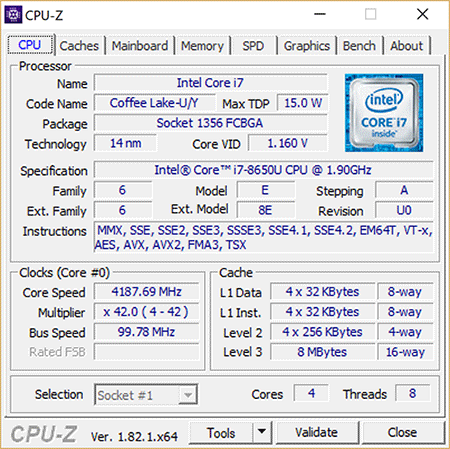
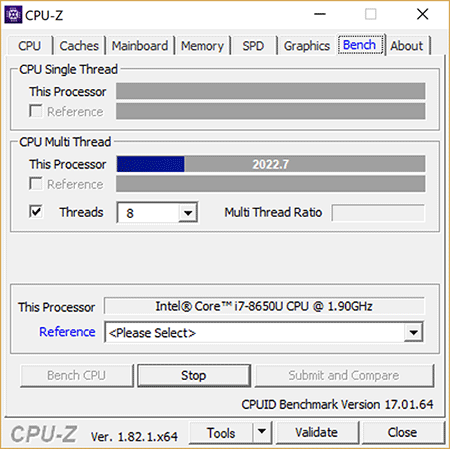
When starting out a heavy load, the Surface Book 2 does indeed kickoff out with an impressive speed to give superlative operation when needed. To put a huge load on the CPU, I ran the "CPU Multi Thread" load in CPU-Z with a total of 8 threads. The benchmark showed around 2022.vii in the beginning, with the speed slowly coming down to lower numbers as time passed on and CPU heated up. After about xv-20 minutes, the CPU indeed slowed down. The slowdown is likely a result of thermal management to protect the CPU from overheating and potential damage when information technology is under continuous heavy load. We can see the resulting behavior in the below screenshot:
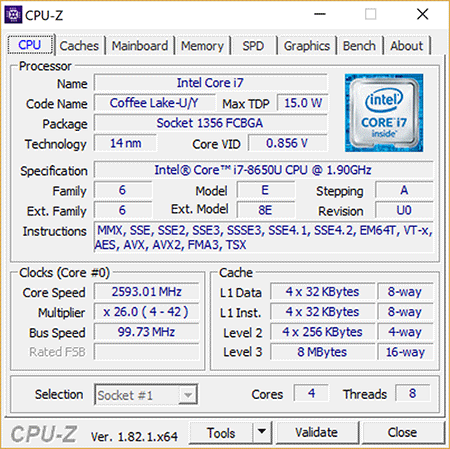
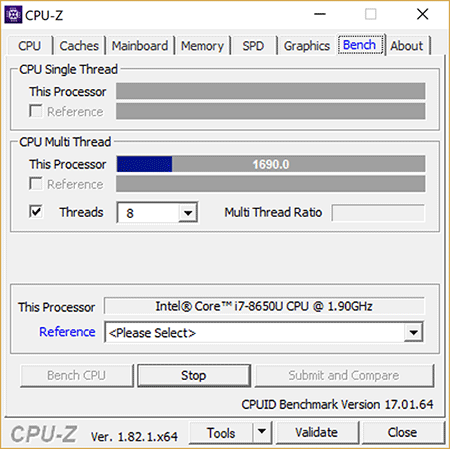
As you can run into, the CPU throttled down to around two.6 Ghz from four.ii Ghz where information technology initially started. The multi-thread operation went from 2022.7 to around 1690.0 in benchmarks, and so roughly a 16.5% drop. Just the slowdown from 4.two Ghz to 2.half-dozen Ghz is a much bigger figure – that's about a 38% difference in core speed, which is a pretty big reduction in performance. Hence, the claim about the CPU of the Surface Book 2 slowing down overtime turned out to be quite authentic, which is important for those who are planning to run heavy loads on this machine. But more on that afterwards…
What about GeekBench 4? This criterion did non turn out to exist particularly useful, mostly because it did not challenge the CPU long enough. The Surface Volume 2 scored 4779 for unmarried-cadre functioning, whereas its multi-core functioning peaked at 13901. In comparing, the MacBook Pro scored 4189 for single-core performance and 14483 for multi-core. A pretty big difference in unmarried-cadre functioning at peak load when the CPU is cool, simply I knew I had to test the two side-by-side much more to see what results I would get, peculiarly on heavy continuous load. Interestingly though, the multi-core performance looked better on the MacBook Pro correct off the bat. And then I decided to burn up Prime95 for a prolonged period of time. And the results were quite interesting to observe.
I ran a 2048K FFT to 4096K FFT load with 4 Threads and Hyperthreading on both machines and I got them to scream – literally! The fan on the MacBook Pro kicked off later almost a minute and got very loud after another few minutes – much louder than the fan on the Surface Book 2. The latter was definitely making noise, but information technology was so much quieter in comparing. Part of the reason is thermal management. Since the MacBook Pro has 2 holes on the bottom sides of the laptop that push air, when the machine sits on top of a desk, it produces noticeably more than audio when compared to the Surface Volume two, since the fan sound is reflected off the desk surface. Another reason is the fan itself – it only sounds like the MacBook Pro has a more than powerful fan when compared to the Surface Book ii. Even so, that's not the important part…let's talk almost actual performance differences.
With both machines starting the CPU criterion at the same time, I expected the Surface Book ii to score better during the initial loads and slowdown to slower speeds at later loads, given the prior CPU-Z runs. And that's exactly what happened – the Surface Book 2 started off at 306.98 iterations/sec on the 2048K FFT length for single-core workload, while the MacBook Pro started noticeably slower at merely 209.96 iterations/sec:
Surface Book 2:
Timing 2048K FFT, iv cores, 1 worker: 3.26 ms. Throughput: 306.98 iter/sec.
Timing 2048K FFT, 4 cores, 4 workers: 14.31, 14.55, 14.50, fourteen.50 ms. Throughput: 276.51 iter/sec.
Timing 2048K FFT, 4 cores hyperthreaded, one worker: 3.45 ms. Throughput: 290.fifteen iter/sec.
Timing 2048K FFT, iv cores hyperthreaded, 4 workers: 15.55, xv.41, 15.52, 15.43 ms. Throughput: 258.forty iter/sec.
MacBook Pro:
Timing 2048K FFT, four cores, 1 worker: 4.76 ms. Throughput: 209.96 iter/sec.
Timing 2048K FFT, 4 cores, 4 workers: thirteen.01, 13.00, 13.03, 12.81 ms. Throughput: 308.66 iter/sec.
Timing 2048K FFT, 4 cores hyperthreaded, 1 worker: 5.75 ms. Total throughput: 173.88 iter/sec.
Timing 2048K FFT, iv cores hyperthreaded, 4 workers: xiv.27, xiv.17, 14.30, 14.20 ms. Total throughput: 280.99 iter/sec.
However, for multi-cadre performance with hyperthreading and four workers, the MacBook Pro scored a bit faster at 280.99 iter/sec compared to 258.twoscore iter/sec on the Surface Book 2, which is similar to what both GeekBench and Cinebench revealed before. So to start off, the Surface Book was effectually 46% faster in single-core performance and about 8% slower in multi-cadre operation.
At around the 3072K FFT marking, the Surface Volume ii was already at 189.80 iter/sec while the MacBook Pro was however rocking at 192.92 iter/sec for single core performance, and that's only in a thing of 7 minutes:
Surface Volume 2:
Timing 3072K FFT, 4 cores, one worker: v.27 ms. Throughput: 189.80 iter/sec.
Timing 3072K FFT, 4 cores, four workers: 21.98, 21.95, 21.78, 22.00 ms. Throughput: 182.45 iter/sec.
Timing 3072K FFT, four cores hyperthreaded, 1 worker: 5.60 ms. Throughput: 178.42 iter/sec.
Timing 3072K FFT, 4 cores hyperthreaded, iv workers: 23.58, 23.43, 23.44, 23.47 ms. Throughput: 170.37 iter/sec.
MacBook Pro:
Timing 3072K FFT, iv cores, one worker: 5.18 ms. Throughput: 192.92 iter/sec.
Timing 3072K FFT, four cores, 4 workers: 19.71, xix.47, nineteen.55, xix.76 ms. Throughput: 203.87 iter/sec.
Timing 3072K FFT, four cores hyperthreaded, one worker: seven.60 ms. Throughput: 131.62 iter/sec.
Timing 3072K FFT, 4 cores hyperthreaded, 4 workers: 21.44, 21.52, 21.55, 21.54 ms. Throughput: 185.96 iter/sec.
And here is what the end of the run at 4096K FFT looked like, after about fifteen minutes:
Surface Volume 2:
Timing 4096K FFT, 4 cores, ane worker: 7.67 ms. Throughput: 130.37 iter/sec.
Timing 4096K FFT, 4 cores, four workers: 31.20, 31.03, thirty.95, xxx.88 ms. Throughput: 128.98 iter/sec.
Timing 4096K FFT, 4 cores hyperthreaded, i worker: vii.99 ms. Throughput: 125.17 iter/sec.
Timing 4096K FFT, iv cores hyperthreaded, 4 workers: 32.71, 32.17, 32.47, 32.06 ms. Throughput: 123.63 iter/sec.
MacBook Pro:
Timing 4096K FFT, 4 cores, 1 worker: half-dozen.68 ms. Throughput: 149.68 iter/sec.
Timing 4096K FFT, 4 cores, 4 workers: 26.58, 26.43, 26.63, 26.41 ms. Throughput: 150.87 iter/sec.
Timing 4096K FFT, 4 cores hyperthreaded, 1 worker: x.40 ms. Throughput: 96.19 iter/sec.
Timing 4096K FFT, four cores hyperthreaded, iv workers: 28.81, 28.71, 28.68, 28.67 ms. Throughput: 139.29 iter/sec.
Towards the finish, the Surface Volume 2 could not go along up with the MacBook Pro, running 130.37 iter/sec compared to 149.68 iter/sec for single-core performance and 123.63 iter/sec vs 139.29 for multi-core + hyperthreading enabled. This represents about a 13% difference in single-core and xi% divergence in multi-core performance between the 2 machines. I ran another benchmark pushing the load all the way to 8192K and below are the results, afterward roughly 30 minutes:
Surface Book 2:
Timing 8192K FFT, iv cores, 1 worker: 18.18 ms. Throughput: 55.00 iter/sec.
Timing 8192K FFT, 4 cores, 4 workers: 72.30, 72.12, 72.16, 71.99 ms. Throughput: 55.44 iter/sec.
Timing 8192K FFT, 4 cores hyperthreaded, 1 worker: 20.50 ms. Throughput: 48.79 iter/sec.
Timing 8192K FFT, four cores hyperthreaded, 4 workers: 77.59, 79.07, eighty.06, 77.29 ms. Throughput: l.96 iter/sec.
MacBook Pro:
Timing 8192K FFT, iv cores, ane worker: xiv.xv ms. Throughput: lxx.67 iter/sec.
Timing 8192K FFT, 4 cores, 4 workers: 56.61, 56.67, 56.54, 56.73 ms. Throughput: 70.63 iter/sec.
Timing 8192K FFT, iv cores hyperthreaded, one worker: sixteen.14 ms. Throughput: 61.95 iter/sec.
Timing 8192K FFT, iv cores hyperthreaded, 4 workers: sixty.60, threescore.48, 60.91, 60.65 ms. Throughput: 65.94 iter/sec.
Information technology looks like CPU throttling continued afterwards the 15 minute mark, since operation somewhen dropped by 22% on the Surface Book two for single-core and past 23% for multi-core benchmarks – a rather significant alter compared to where the two CPUs started.
However, these numbers notwithstanding don't fully correspond to the speed differences I saw in Lightroom, which showed MacBook Pro outperforming the Surface Book two by as much every bit 40%. Where do these drastic performance differences come from? After doing a more thorough CPU evaluation, I can conclude that it is the combination of the faster, non-throttled CPU with much faster storage on the MacBook Pro that together upshot in big functioning differences between the 2 machines.
Summary
Running both Surface Book 2 and MacBook Pro side-by-side for a month has been a fun experiment. I take been wanting to upgrade my crumbling laptop for a while now and when Microsoft announced the Surface Book ii, I knew that I had to requite it a endeavor to run across if it would fit my needs. And although I am not a heavy Mac user (only utilise an iMac, primarily for workshops), I knew that I had to bank check out the latest MacBook Pro models as well and compare them directly with the Surface Book ii to see which 1 would win me over.
While the Surface Book 2 looks quite appealing with its impressive 2-in-one tablet / laptop setup, an excellent touchscreen and many other features highlighted in this article, when it comes to sheer power, information technology simply cannot compete with the MacBook Pro. As can be seen from in a higher place tests, the Surface Volume 2 starts to throttle its CPU speed quite a bit with heavy loads, noticeably bringing its performance downward. That'due south understandable, given that the top function of the machine houses all the core components such every bit the display, CPU, RAM and bombardment – that's a lot to continuously keep absurd. Throttling the CPU is necessary for proper thermal direction on a compact machine like this and that's where its biggest weakness lies equally a two-in-one when compared to a traditional laptop such as the MacBook Pro. In addition, the MacBook Pro has much faster storage, which is certainly important when building Lightroom previews, or exporting images. Just put, if you lot want to be able to get the best performance out of Photoshop and Lightroom, MacBook Pro is the fashion to go. Initially, I was unhappy about lack of USB ports on the MacBook Pro, but as our readers have pointed out, those turned out to exist mostly non-issues. One can replace standard USB cables with Thunderbolt types at relatively low toll and in situations where information technology is not possible to replace the whole cable, a modest Thunderbolt to USB adapter tin be used to plug in USB devices.
The Surface Book 2 has a lot to similar about it. It has a wonderful LCD screen that is easy to accurately calibrate using 10-Rite i1Display Pro + DisplayCAL (I was able to get very authentic colors afterwards a single calibration run). One can utilize the Surface Pen to describe on the screen, thus removing the need to acquit a dedicated Wacom device. It has a powerful NVIDIA GeForce GTX 1060 dedicated GPU that makes the machine fly when running GPU-intensive tasks and playing games – much better than what one can accomplish with the MacBook Pro'south AMD Radeon Pro 560 GPU. The Surface Volume 2 gets warm, but never actually too hot when working, which makes it more pleasant to utilize compared to the MacBook Pro, which tin get very hot when working in Photoshop and Lightroom, making it a poor candidate for lap work. At the same time, the CPU throttling and the poor (in comparison) storage functioning of the Surface Book ii are rather disappointing. While there is zip one tin can do about CPU functioning, the only way to get faster storage is to move upwards to the much more expensive 1 TB storage choice, which is more money to spend on an already expensive car. I am not certain why Microsoft opted for a slower 512 GB NVMe drive – it shouldn't accept been far behind the MacBook Pro in that regard.
It looks like at that place is no clear winner hither. If yous want the all-time overall performance for mail-processing and you don't game much, MacBook Pro is the way to go. If you similar the two-in-ane tablet / laptop approach and want specific features such equally the touchscreen, the Surface Volume 2 is mayhap one of the best PC laptops on the marketplace today…
Source: https://photographylife.com/microsoft-surface-book-2-vs-apple-macbook-pro
0 Response to "Surface Book 2 Review From a Mac User"
Post a Comment